This Annual, Non-Native Flower Kicks Off Our Restoration Process. Here’s Why.
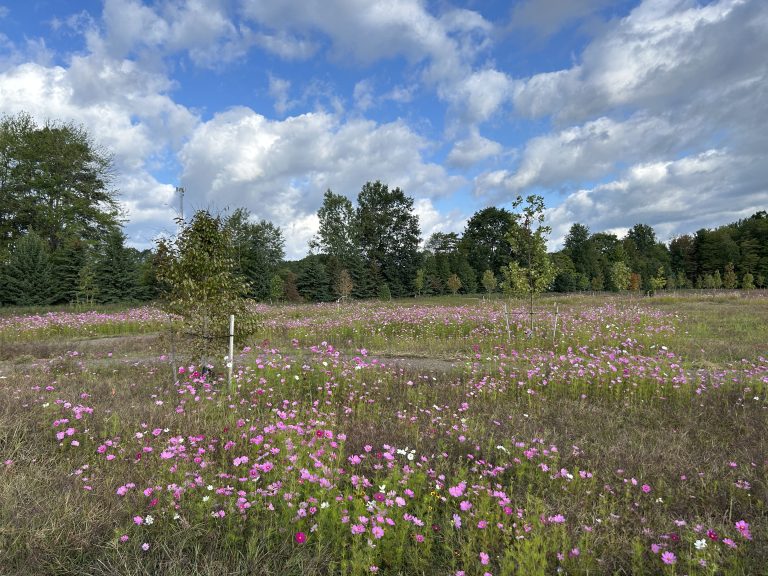
If you’ve driven past one of our new restoration sites this summer and seen a field bursting with cosmos, you might have some questions. Cosmos are annuals, not native to Michigan. But they play a specific role in how we approach a full-scale prairie restoration.
Why Cosmos Are Often Used at the Beginning of a Prairie Restoration
When we convert a mowed lawn or old pasture into native prairie, we often use a supplemental starter mix alongside the native prairie seed. That starter mix includes quick-establishing species like cosmos, tickseed, blanketflower, and partridge pea. These plants germinate fast and put on a big, colorful show in the very first year—long before the native prairie plants have done much visible growing at all.
Most native prairie species spend their early life building extensive root systems underground rather than putting energy into height or flowers. A newly seeded prairie can look like bare dirt for months while all the real work happens below the surface. The starter mix fills that gap.
Native Prairie Restoration Is a Multi-Year Effort, Not a One-Season Transformation
Cosmos and their companions aren’t here to stay—they won’t be reseeded year after year. As native plants like coneflowers, coreopsis, asters, milkweeds, goldenrods, and a variety of grasses continue developing their root systems, they gradually take over, filling in the space the early annuals once occupied. Over a few growing seasons, the balance shifts: the short-lived, early-establishing species fade out, and the longer-lived native community becomes the backbone of the prairie.
By year three or four, a well-established site looks completely different from that first-year. The result is a landscape that is structurally diverse, more resilient, and built to support pollinators and wildlife for decades rather than a single season.
The Work Behind Every Acre We Restore
Prairie restoration is one piece of a much larger effort. Across West Michigan, our Conservation Services team partners with municipalities, businesses, schools, and private landowners to restore ecosystems, improve wildlife habitat, and steward the natural systems that support clean water and thriving wildlife. In 2025 alone, that work meant managing more than 2,500 acres of natural area and restoring over 35 acres of native grassland habitat.
As more properties across the region are restored, they begin to link up into larger networks of habitat—rebuilding the corridors that let plants and wildlife move, spread, and thrive across property lines. Cosmos are just one brief chapter in that much bigger story.
To learn more or start a project of your own, visit our Conservation Services page.
Related Posts
This Annual, Non-Native Flower Kicks Off Our Restoration Process. Here’s Why.
How We’re Tracking Lake Macatawa’s Water Quality in Real Time

How We’re Restoring Lake Macatawa—and Protecting Its Future

Plan Your Visit to the Cultural History Center

How ODC Network’s Cultural History Center Brings State Education Standards to Life